
BabelBird MCP
BabelBird MCP is a standards-based bridge between enterprise files and AI agents. Codex, WorkBuddy, OpenClaw, and other MCP-compatible agents can find and read authorized files, query enterprise knowledge, retrieve similar images, and upload project outputs to an authorized BabelBird folder.
MCP does not bypass BabelBird permissions. Effective access is the intersection of the user's existing permissions, API Key scopes, allowed folders, and enterprise security policy.
The fixed BabelBird public-cloud MCP URL is https://www.babel.cc/mcp. Every public-cloud user connects to this same URL and is identified and authorized by their own API Key. Creating another API Key does not create another MCP URL.
What It Can Do
| Capability | Agent action | Main tools |
|---|---|---|
| Project workspace | Select an authorized folder as the project workspace | babel_get_workspace, babel_set_workspace |
| Recent uploads | Get recently uploaded or updated files | babel_get_recent_files |
| Knowledge query | Query the BabelBird vector store and return source files | babel_query_knowledge |
| Similar images | Find similar images from text or an existing image | babel_find_similar_images |
| File-name search | Search file names by keyword | searchFileNameByKey |
| Folders and metadata | List a folder or resolve information by path | ListFolder, getFileInfoByPath |
| Read and download | Read content or request a download URL | getFileContent, getDownloadUrl |
| Create and upload | Create a folder and request an upload URL | createFolder, getUploadUrl |
| Usage and quota | Check used storage and available quota | getUsageAndQuota |
Five-Minute Quick Start
1. Create a Dedicated API Key
In BabelBird, open “Settings > API Keys” and select “Create API Key.” A user can create multiple API Keys. Use a separate key for each agent and purpose, such as Codex-Engineering, WorkBuddy-Marketing, or OpenClaw-Knowledge, so each credential can have its own scope, audit trail, and lifecycle.
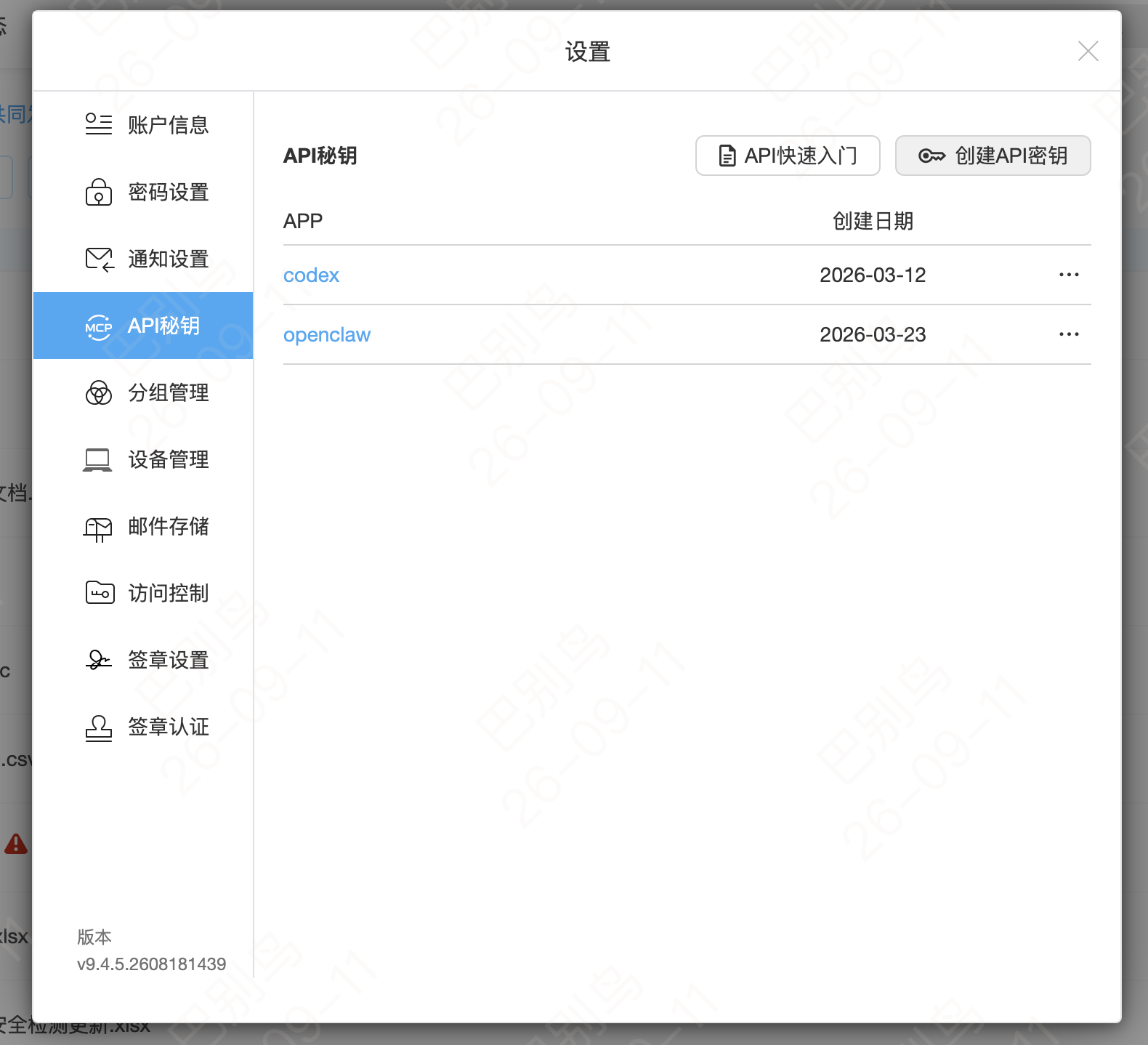
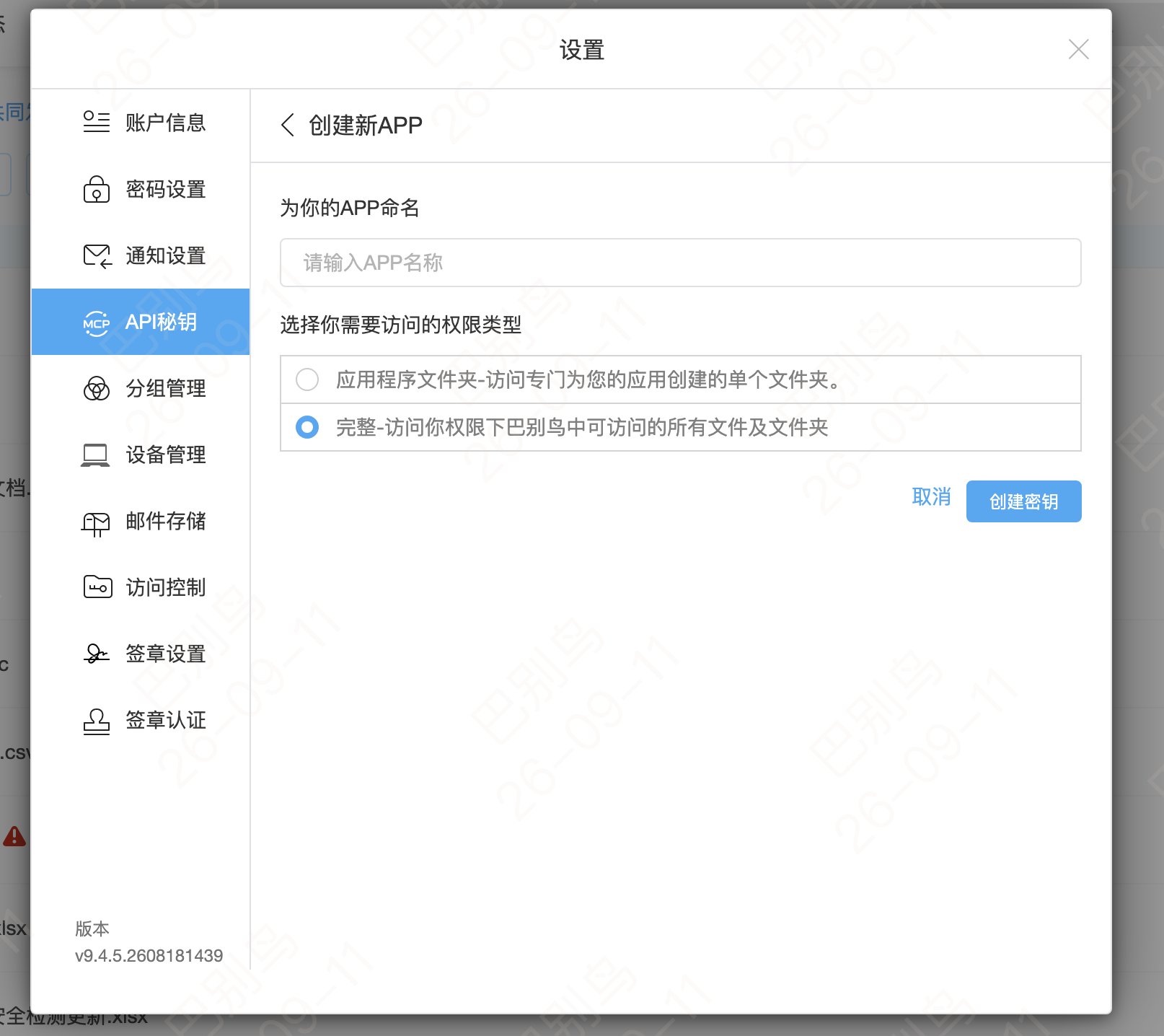
After selecting Create API Key, enter an application name and choose an access type:
- Application folder: BabelBird creates one dedicated folder for the application. The agent can only access that folder, making this the preferred choice for a bounded project workspace.
- Full access: the application can access files and folders the current user is already allowed to access. Use this broader option only when cross-folder retrieval is required.
After creation, open the application to review its APP Key, APP Secret, accessible scope, OAuth 2 redirect URI, access token and file permissions.
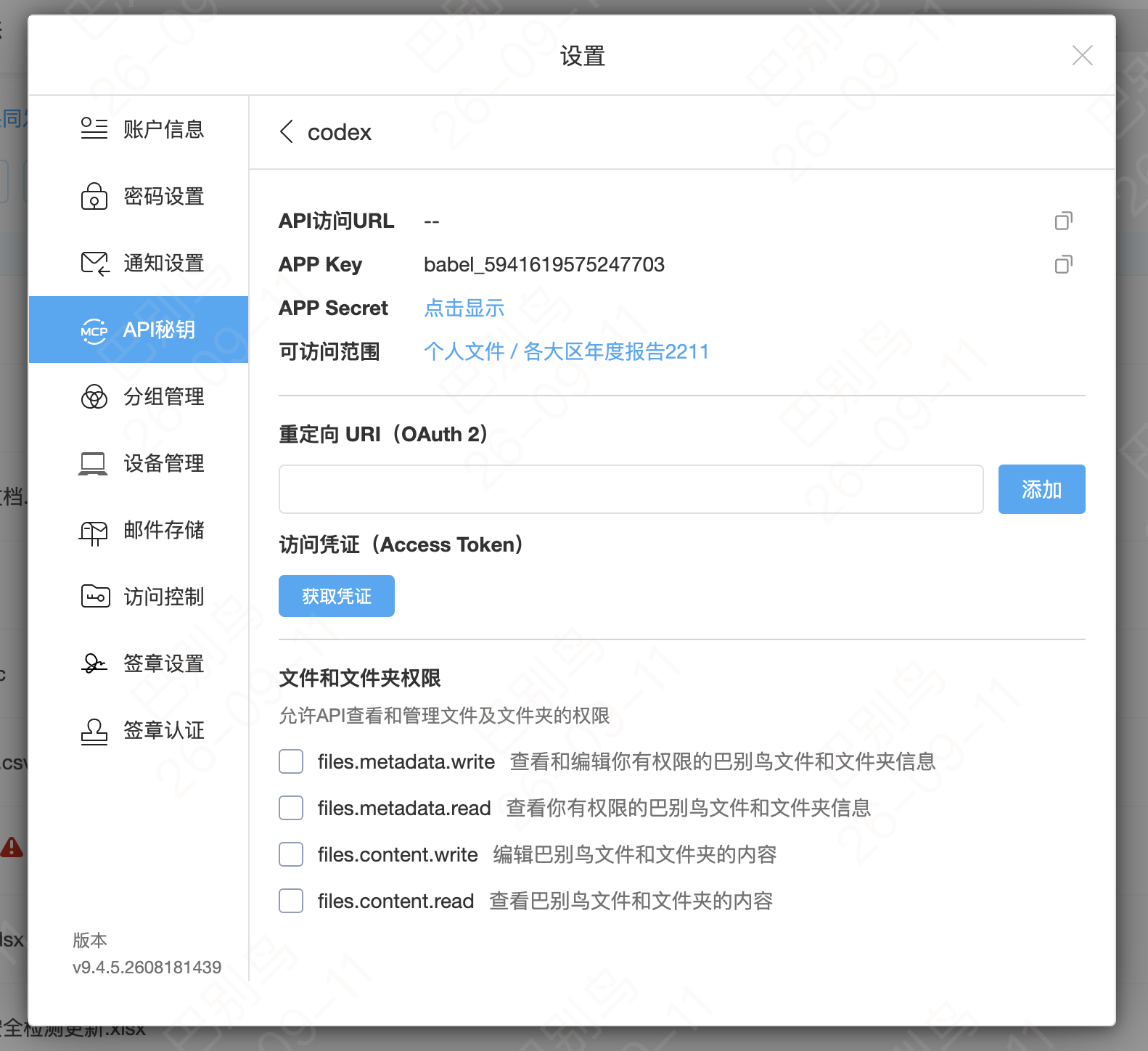
Confirm the following settings:
- Accessible scope: prefer an application folder, and use full access only when needed. Neither option expands the current user's original permissions.
files.metadata.read: list folders, search file names, and read file metadata.files.content.read: read file content or request download URLs.files.metadata.write: create folders or update file metadata.files.content.write: request upload URLs and upload into authorized folders.- Search, knowledge, and image retrieval scopes: enabled according to product edition and enterprise policy.
The redirect URI and access token support OAuth 2 integration flows. They are not required merely to discover the MCP URL when using the one-instruction API Key connection described here, because the public-cloud MCP address is fixed.
Use an API Key only in a trusted environment. Never paste it into a group chat, ticket, public screenshot, or source repository. Disable and replace it immediately if it may have been exposed.
2. Connect with One Instruction
Send the following instruction to an agent that can configure MCP automatically. Only replace the API Key placeholder:
Connect BabelBird MCP for me. Name it BabelBird, use https://www.babel.cc/mcp as the URL, and authenticate with API Key <YOUR_API_KEY>. After setup, list the available tools and run one read-only connectivity test.The public-cloud URL is fixed. If an agent cannot configure MCP automatically, add a remote MCP server manually, use https://www.babel.cc/mcp as its URL, and enter the API Key created by the current user.
For Codex, use an environment variable so the API Key is not stored directly in the configuration file:
[mcp_servers.babelbird]
url = "https://www.babel.cc/mcp"
bearer_token_env_var = "BABELBIRD_API_KEY"
3. Verify the Connection
List the available BabelBird MCP tools. Do not perform any write operation.Show my BabelBird storage usage and quota, then list my 10 most recently uploaded files.If getUsageAndQuota and the recent-file query both return results, the fixed URL, API Key, and read permissions are working.
4. Select a Project Workspace
Before writing, use ListFolder to browse Personal Files or the target project, then select an authorized folder:
List the folders under “Personal Files/AI Projects,” then use “Website Redesign” as the workspace. Only upload new files into that folder, and ask before updating an existing file.The agent should not upload when no workspace is selected, the folder is outside the API Key scope, or content write permission is missing.
Common Workflows
Find and read a file
- Use
searchFileNameByKeyto find candidates by file-name keyword, or browse withListFolder. - Use
getFileInfoByPathto confirm the path, type, size, and updated time. - Use
getFileContentto read content, orgetDownloadUrlto download the original file.
Create a folder and upload a file
- Use
createFolderin Personal Files or another authorized folder. - Use
getUploadUrlfor the destination folder and file name. - Upload to the returned URL, then verify with
ListFolderorgetFileInfoByPath.
Query knowledge and images
- Use
babel_query_knowledgefor vector search and source retrieval. - Use
babel_find_similar_imagesto retrieve similar images from text or an image file while respecting user permissions.
Prompt Examples
- “Show current storage usage and remaining quota.”
- “Get files uploaded in the last seven days and sort them by updated time.”
- “Query the BabelBird knowledge base for ‘contract archiving workflow’ and cite the source files.”
- “Search file names for ‘East China channel policy’ and return only files I can access.”
- “List PDFs under Personal Files and read the meeting notes.”
- “Find the top 20 images similar to file ID
xxxxand include their folders.” - “Create
AI Projects/Quarterly Review, request an upload URL, and save this output there.”
MCP Tool Catalog
Tool names are case-sensitive. Use the exact names below.
| Tool | Purpose | Type |
|---|---|---|
ListFolder |
List files and subfolders in a folder or current workspace | Read-only |
getFileContent |
Read the content of an authorized file | Read-only |
getUsageAndQuota |
Return used storage and available quota | Read-only |
getDownloadUrl |
Return a download URL for an authorized file | Read-only |
searchFileNameByKey |
Search file names by keyword | Read-only |
getUploadUrl |
Request an upload URL for a destination folder and file | Write preparation |
createFolder |
Create a folder in Personal Files or an authorized location | Write |
getFileInfoByPath |
Resolve file or folder information from a full path | Read-only |
babel_get_workspace |
Return the selected project workspace and access mode | Read-only |
babel_set_workspace |
Select an authorized folder as the current workspace | Context setting |
babel_get_recent_files |
Return recently uploaded or updated files | Read-only |
babel_query_knowledge |
Query enterprise knowledge or vector search and return sources | Read-only |
babel_find_similar_images |
Retrieve similar images from text or an image file ID | Read-only |
The current catalog does not expose high-risk operations such as delete, move, external sharing, or permission changes. Before calling getUploadUrl or createFolder, the agent should identify the destination and intended operation and check for existing files.
Permissions and Security
- Inherit user permissions: MCP can only access content the current user can already view or edit.
- Restrict folders: each API Key can be limited to one or more allowed folders.
- Separate read and write scopes: search and read access do not imply upload access.
- Use one key per agent: separate API Keys simplify revocation and auditing.
- Keep an audit trail without recording the API Key value.
- Minimize output and only return the fields or excerpts required for the task.
- Identify the destination and file name before requesting an upload URL.
FAQ
Does the public-cloud MCP URL change by user or API Key?
No. The BabelBird public-cloud MCP URL is always https://www.babel.cc/mcp. Users and agents are identified and authorized with their own API Keys.
Can one user create multiple API Keys?
Yes. Use separate keys for different agents, projects, or permission scopes. Disabling one API Key does not affect the others.
Why can the agent not find a file?
Check the user's original permission, the API Key folder scope, the read scopes, and whether the file has completed search or vector indexing. MCP never expands the user's existing access.
Why does upload begin with getUploadUrl?
getUploadUrl validates the destination and returns an upload URL. Define the folder and file name first, upload to the returned URL, and verify with ListFolder or getFileInfoByPath.
Which URL is used for a private deployment?
The fixed https://www.babel.cc/mcp URL is for BabelBird public cloud only. A private deployment uses the enterprise's own MCP URL, provided by its administrator or implementation team.
How It Works
Codex / WorkBuddy / OpenClaw / Other agents
                       │
       Fixed URL https://www.babel.cc/mcp
                    + API Key
                       │
                       ▼
                 BabelBird MCP Gateway
       Identity · permission intersection · scope · audit
             ┌─────────┼─────────┐
             ▼         ▼         ▼
          Files     Search/OCR  Zhichao AI
                              Vector/Image Search